
 CNS 2026 guest post by Taryn Green and Frederik Bergmann (CNSTA)
Perhaps now more than in previous years, as career opportunities seem to grow thinner especially with recent funding cuts to U.S. federal research, PhD students and postdocs face pressing decisions about next steps, career development, and sustaining momentum. At the same time, maintaining work-life balance is of utmost importance. As such, navigating a research career requires balancing the promise and uncertainties of academia with all the practical challenges that come with shifting environments and personal goals
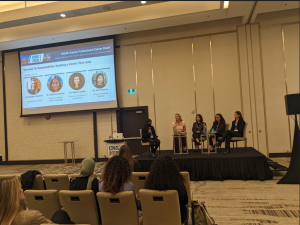
At the 2026 CNSTA Career Panel, held during the Cognitive Neuroscience Society (CNS) annual meeting in Vancouver, Canada, four scientists shared insights into their strategies for building a coherent research identity.
Building Sustainability Through Balance and Growth
During the panel, Morgan Barense of the University of Toronto emphasized the importance of pursuing high-quality research while maintaining balance with personal life and obligations. She noted that identifying role models who embody this balance can help make long-term goals more tangible.
Caterina Gratton of the University of Illinois at Urbana-Champaign echoed the value of role models, particularly in demonstrating that it is possible to integrate family life with an academic career. She emphasized that sustainability often involves embracing change, including relocation and evolving opportunities, while prioritizing overall well-being.
Similarly, Hee Yeon Im of the BC Children’s Hospital Research Institute reflected on her experience transitioning from Korea to graduate training abroad. She highlighted the need to allow oneself time to grow, as she herself needed time to adjust to a different culture whilst also maneuvering grad school.
Regina Lapate of the University of California, Santa Barbara, shared that, as a graduate student, she was uncertain about her long-term trajectory and instead focused on continuing her work as long as it remained meaningful and engaging. Together, the panelists’ perspectives underscore that sustainable academic careers are dynamic, deeply personal, and often shaped through ongoing adaptation rather than precise long-term prediction.
Cultivating Collaborations and Networks
“Look around and see who is living that sort of a life that looks like something that you might want to have.” – Morgan Barense
Much of the discussion around networking centered on mentorship, but not only in the traditional sense. In addition to senior mentors, panelists emphasized the importance of “lateral mentorship”: peer relationships that provide day-to-day support, collaboration, and a sense of community. These connections, often informal, are equally valuable and can become some of the most stable parts of an academic career.
Building these relationships does not necessarily follow a formal structure. Panelists described connecting with peers at conferences or workshops, or getting involved in collaborative projects, as Im suggested, as practical ways of expanding their network. In many cases, collaborations emerged less from strategic planning and more from ongoing conversations and shared interests. But also directly reaching out to graduate students, postdocs, or more senior investigators can open doors to meaningful connections.
While proactivity is key to finding and maintaining such relationships, the discussion also suggested that networking is not always a separate task. It is often embedded in the work itself, through engaging with others’ research and sharing ideas.
Managing Transitions on the Road to Success
“You’ll never feel ready. […] So don’t wait until you feel ready. If there is a job that has come up that feels like it’s right, go for it, and sort the rest of that stuff out later.” – Caterina Gratton
The discussion of postdoctoral training made one point clear: There is no moment at which you suddenly feel ready, whether applying for postdocs or faculty positions, and that waiting for that feeling can be counterproductive. As Gratton put it, you might never feel ready, and don’t wait until you do. Waiting for certainty, in that sense, can become a way of delaying the next step.
At the same time, panelists agreed that developing a clear research identity matters. This does not necessarily come from accumulating as many projects or awards as possible, but from doing work that is coherent and genuinely interesting. Building a body of work that others begin to associate with you — rather than chasing external validation — was described as more important than optimizing for short-term markers of success.
More practical advice focused on what is actually within reach and what you can actually control: applying broadly, reaching out to potential collaborators or mentors, and continuing to develop skills through hands-on research. Taken together, the discussion suggested that progress at this stage is less about following a predefined plan and more about continuing to move forward despite uncertainty.
There is no formula for success. Building a career in academia, we learned, is an ongoing process that takes shape over time with the help of many.
—
Taryn Green is a PhD student at Louisiana State University, where her research focuses on the limitations on visual working memory and the neural correlates underlying these processes. Frederik Bergman is a postdoctoral fellow at the University of Colorado Boulder, where his research focuses on semantic memory, memory suppression, and fMRI.
