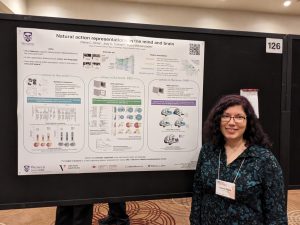
 CNS 2024
Every day, we have an almost nonstop view of different actions unfolding around us, whether in traffic watching cars, on TV observing people interact, or at a park seeing dogs and kids playing. For scientists trying to understand how we take in such visual information, it is often easiest to isolate certain features, for example using 2-D images. But in a new study, presented at an award-winning poster at CNS 2024, researchers instead used videos to capture how people think about multiple features of actions and how they are organized in the brain.
Diana Dima of Western University in Ontario, who received a CNS Postdoctoral Fellows Award (PFA) for her poster describing this work, wanted to see how people grouped actions together based on their similarities or differences. She showed participants videos of everyday actions like running, cooking, socializing and asked them to categorize the actions while also gathering fMRI and EEG data.
“Do they categorize actions by their category (e.g. cooking or working), by the setting in which they take place (indoors or outdoors), by the number of people taking part, or by the target of the action, i.e. whether the action is directed towards an object, another person, or the self?” she explains. “It turns out the latter determines how people categorize actions, more so than any other aspect, including the category of the action.” These findings therefore suggest people lean into social features when processing everyday actions.
I spoke with Dima to learn more about the work and its significance, as well as her experience at CNS 2024 in Toronto.
CNS: What got you first interested in cognitive neuroscience?
Dima: I have a non-traditional background, having studied History as an undergraduate. My interest in Psychology was ignited by some volunteering experiences and courses I attended, and this led to an interest in the intersection of biology and behavior. Cognitive neuroscience allowed me to delve into what is to me one of the most interesting unanswered questions, which is how our brain supports our internal experience and behavior.
CNS: Why do you want to understand how action representations are organized?
Dima: A lot of what we know about the visual system comes from thoughtful investigations using stimuli designed to isolate single features of the visual world. But in our everyday experience, we see an endless stream of complex, constantly moving scenes. Today’s computational and imaging tools allow us to use more and more naturalistic stimuli and understand how we make sense of our everyday visual experience.
Our work on action representations is a step in this direction. Actions are a huge part of what we see every day; we see people doing various things in different contexts, and in a fraction of a second, we’re able to understand what we’re seeing and decide on our own course of action. I use videos of everyday actions to understand how we do this, and combine fMRI and EEG to look at how actions are processed in different regions of the brain over time.
CNS: What were you most excited to find in your research?
Dima: One of the most interesting findings was that when asked to categorize actions, people tend to categorize them according to their goals: for example, whether the actions are directed towards another person or an object. This information is extracted automatically in the brain when we view actions, and it seems to determine how we think about them. I found this particularly interesting because it suggests a strong social component to how we perceive the events around us.
CNS: What was the CNS 2024 experience like for you?
Dima: CNS was a fantastic conference! I particularly enjoyed the historical perspectives on memory research, and Kia Nobre’s overview of the directions that have shaped and are likely to shape neuroscience research was inspiring.
I was honored to receive the PFA and it was a great help in making the most of CNS.
-Lisa M.P. Munoz

Leave a Reply
You must be logged in to post a comment.