CNS 2026 Q&A with Peter Hagoort
From his days as an undergraduate student assistant at the Max Planck Institute for Psycholinguistics to his work now as Director of the Institute, Peter Hagoort has come full circle in his career, seeking to unlock the mechanisms of language in the brain. For more than four decades, he has worked to understand how people seemingly automatically develop the capacity for advanced communication and what happens when that goes wrong.
The work is highlighting the complexity of language, its intricate organization in the brain, and how it is influenced by various other brain networks. Hagoort will share these insights in the keynote talk at the annual CNS meeting this March in Vancouver. We spoke about his early work in the field, what drives his research forward, technological advancements, how his lab balances fundamental research with translational work, and advice he has for early-career researchers.
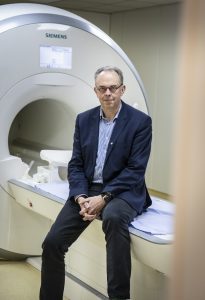 CNS: How did you first become interested in studying language in the brain?
Hagoort: When I was an undergraduate student [studying psychology and biology], I was recruited for a project that developed a test for aphasia in Dutch. It was a student assistantship in which I went to rehabilitation centers, elderly homes, and so on, to test aphasia patients in order to standardize the test battery.
In this work, I came across something which I had not realized before: that something small can go wrong in the brain and all of a sudden, this complicated system that we command, speaking and listening to each other, starts to fail at multiple levels. I found that very intriguing, to realize that what we automatically do every day is actually based on something very intricate. That is how I became interested in the relationship between language and the brain. From then on, the rest of my career was based on that particular experience.
CNS: How has your perspective on aphasia changed since that time as an undergraduate?
Hagoort: During the assistantship, I was focused on the symptoms. But later in my career, I got more into the research aspect of it. Once I started my PhD, we got all the new neuroimaging facilities and tools like fMRI, EEG and PET, scanning so that we could also look at the healthy brain to better understand my experiences with patients. I wanted to know: How is this language system organized in the healthy brain?
And this is the key point I would like to discuss in my keynote lecture at CNS 2026 in Vancouver: What makes the human brain language ready?
Even though the complexities of the grammar are equally or more complex than probably the grammar of the motor task that they do when they learn to tie their shoes, one thing they acquire automatically, and for the other, they need to go to school and learn.
CNS: What makes this an important research question for you?
Hagoort: I still remember my daughter coming home very proudly when she was six years of age, showing her shoe lacing diploma that she acquired at school. Shoe lacing is a simple motor act, but you still have to learn it; it doesn’t come naturally. At the same time, she was already producing and understanding rather complex language. Kids, in their first four years of life, acquire the basics of spoken language without any formal instruction. Even though the complexities of the grammar are equally or more complex than probably the grammar of the motor task that they do when they learn to tie their shoes, one thing they acquire automatically, and for the other, they need to go to school and learn.
This indicates that, in one way or another, the human brain, contrast to other species, is equipped with the the disposition to acquire this system quite automatically. So, I am interested in characterizing the different aspects of language that need to be supported to allow us to communicate. And ultimately, if we want to understand the human condition, then language is key.
CNS: I know you will talk the audience through many aspects of your research during your CNS 2026 keynote in Vancouver, but can you give a little preview of some of the key aspects you will cover?
Hagoort: Yes, of course, I don’t want to give away the whole story before the talk, but one idea
I would like to show is that language has multiple levels. As I talk to you, I’m producing sounds, and you hear the sounds and recognize words and so on. But of course, another layer is that we also, with our linguistic utterances, communicate something beyond the pure linguistic utterance itself.
For example, if I visit you at home and say, “wow, it’s cold here,” you will interpret this very likely as a request to do something about it that’s not in the linguistic utterance itself. This “speaker meaning” is about what I want to achieve with my linguistic utterance, and that’s often more than is encoded in the words themselves. We’ve shown that this requires the contribution of the theory of mind areas in the brain because, in one way or another, as a listener, you have to try to infer what I would like to communicate. That is an additional layer that’s often important in human communication, and that can also work less optimally in people with some limitation in their communicative skills.
So the overarching thing that I would like to show is that if you talk about language, in contrast to some of the restricted linguistic theories about syntax, it requires the contribution of multiple different networks that are all crucial for getting communication going.
CNS: In addition to the imaging advancements you mentioned earlier, have there been other technological advancements that have contributed to the study of language in the brain in recent years?
Hagoort: Yes, a recent development is the large language models. With AI development , for the first time now, homo sapiens is no longer the only species that produces language at a more sophisticated level. We are entering an era in which we have artificial systems that also produce language, and these models can be used to also investigate and make certain predictions that are very precise in terms of which aspects of the brain might contribute to what aspects of language.
In general, I use all the tools of neuroscience, so to speak, to try to get as complete a picture as possible of the organization language in the brain.
CNS: What is the relationship between fundamental and translational research in your work?
Hagoort: I am at an institute that’s purely devoted to fundamental research, so that is the focus. However, there have been some translational aspects. For example, my lab developed a project that optimized a reading program for kids who have some problems learning to read. We have also developed some aphasia therapy apps. However, the key feature of my research is work to understand the fundamentals of language, and I think we have made progress. But the brain is complicated. The language system is complicated. Therefore, I am a bit hesitant to journey too quickly to translation before we have a solid understanding.
I also think it’s important to be open to developments in other fields, which is why the Cognitive Neuroscience Society meeting is so relevant.
CNS: What advice do you have to young researchers just starting in cognitive neuroscience?
Hagoort: My general message is to carefully listen to your supervisors, but don’t listen too well because you also need to carve out your own course. The older you get, the more conservative you might be in terms of new developments and breakthroughs, and the younger generation is often more open minded. So that’s why it’s good to take advice but also to be a bit stubborn.
At the same time, I also think it’s important to be open to developments in other fields, which is why the Cognitive Neuroscience Society meeting is so relevant. Every student works hard on their own project but it’s also important to create a bigger picture of the field as a whole.
CNS: What are you most looking forward to at the CNS 2026 meeting in Vancouver?
Hagoort: Of course I’m most looking forward to seeing many good old friends. I am also looking forward to seeing Vancouver, as it will be my first time there, and I’m told it’s a nice city. I hope that I can spend some additional days there to look around.
-Lisa M.P. Munoz
