
CNS 2027 Q&A with John Gabrieli
John Gabrieli has had a front-row seat in witnessing the evolution of cognitive neuroscience over the last few decades. From his early work with amnesiac H.M. to a new type of neuroscience enabled by the advent of fMRI, he views his role as exploring the full range of what it means to be a human.
Gabrieli’s body of work, for which he is receiving the George A. Miller Prize at the CNS 2027 meeting in Boston in March, is less about a specific area of cognitive neuroscience and more about a glue that he feels should drive a lot of research in the field: “How can we use cognitive neuroscience to improve outcomes for people in health and happiness?” asks Gabrieli, an investigator at the MIT McGovern Institute for Brain Research. “The idea is not just only describing problems, but using what is learned to contribute to some steps forward in society.”
I spoke with Gabrieli about his early start in research, some exciting recent studies he will present in Boston, and what he is most looking forward to at the meeting.
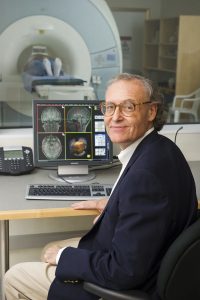
Photographer: Justin Knight
CNS: How did you get started in cognitive neuroscience?
Gabrieli: Almost randomly. I volunteered to be a research assistant in a lab at MIT because following undergraduate school, I was a little uncertain what I wanted to do when I was a grown-up. It turned out to be a cognitive neuroscience lab, although I’m not sure that phrase was around that much at that time. As I was exposed to it, I just loved it. The combination of biology on the one hand and investigating human nature, cognition, and emotion just seemed fascinating. And it was especially easy to get fascinating because Suzanne Corkin was my advisor, and she’d remain my advisor when I got into grad school, also at MIT. She did a lot of work with a very famous patient in our field, H. M.
CNS: Can you describe a bit more of your time working with H.M.?
Gabrieli: H.M. helped researchers figure out how memory works in the brain, with work in Montreal by Brenda Millner. But because H.M. lived in Connecticut, he was closer to MIT, so he would come to MIT for a week or two weeks at a time for a whole series of experiments, and it was unbelievably fascinating. He was a delightful person and super hardworking research participant.
CNS: How did you go from that early work to your broad-spanning research now?
Gabrieli: I kept working on memory for a number of years, and then when I moved to Stanford as a junior faculty member, that was around the time when fMRI began. All of a sudden, instead of being largely dependent on brain injuries and diseases for study, you could explore much more. The entire range of human variation, experience, and challenges became open to study. You could study children. You could study people with medical challenges of various kinds. I ended up doing studies on personality, on cultural influences, on brain functions. I was like a child in a candy shop. I also still focused on memory for a number of years, but opportunities arose to look at other things like dyslexia, ADHD, and autism, which are big areas for me now.
CNS: And so will those areas be the focus on your award talk at CNS 2027 in Boston this March?
Gabrieli: Not exactly. The focus of the talk is going to be about how we might use our knowledge from brain imaging and cognitive neuroscience to understand and improve outcomes for people who face adversity in different ways. This includes developmental differences, like ADHD, dyslexia, and autism, but I’ve also done a fair bit of work on poverty, which has a stunningly big effect on brain development, as well as on depression and anxiety.
CNS: Can you give an example of a study you might discuss in the talk that you are excited about right now?
Gabrieli: One thing I’ve gotten really excited about is the benefits of mindfulness training, and there are two recent studies on this topic. One was having a mindfulness program in a low-income middle school, and seeing both the benefits the children reported, as well as the brain changes that occurred. I will couple that with results from a paper where we did remote mindfulness training via an app for adults with autism who experience high rates of anxiety. We got beautiful findings in terms of the benefits in those individuals.
CNS: What was it like doing research directly in a middle school environment?
Gabrieli: It can be tough to collaborate with school for scientific studies. But this school allowed us to come in and do a randomized control trial during the school day. Some things can up with doing this real-world study. One has to do with degrees of freedom in statistics. The more observations you have, the better. The rule of thumb is if you have two groups of people, like two sets of students who go from together from classroom to classroom, that’s like one sample because they all go together. So, the school actually allowed us to mix up the classes so that the study was fully randomized.
The downside of that was that there were kids in those classrooms who really did not like each other, and who had been separated. Nothing terrible happened but we got back reports from the teacher that they had a couple of like real incidents, so it was an unexpected complexity of doing research in an actual school environment. But we got pretty positive findings – including students reporting less stress in their daily lives – and so that’s encouraging that there’s a path for this type of study that is possible.
CNS: For the remote study that you did on mindfulness training for adults with autism, were you surprised by the findings?
Gabrieli: Yes, I was surprised, but not shocked, it was so good. This was my first study in remote mindfulness, and, of course, what’s awesome about that is it’s so available to people. While mindfulness instruction in schools is hard to instantiate, an app is widely available. In the randomized trial, with half of people doing nothing as a passive control, everything that you would want for a person improved with the one-month intervention – lower anxiety, lower depression scores, better experiences. It was so good that we eventually had the control group use the same remote app, and we replicated the results completely. Then six weeks later, we gave them all the questionnaires again, and they largely sustained all the benefits, even with many people no longer using the app.
CNS: What are you most excited about for CNS 2027 in Boston?
Gabrieli: It’s always great to see science from young new people who you don’t know yet. But I have also been lucky to work with amazing grad students and postdocs for all these years, with at least 50 of them now professors at various universities. Some of them will be there or will have students there representing their labs. That, to me, is super meaningful. Their accomplishments are their accomplishments, but it is highly meaningful to have played a role in their progression, and they certainly played a huge role in the work that I was able to do and will be presenting.
-Lisa M.P. Munoz
