
On a recent trip to Barcelona, my family and I walked through the corridors of the Gothic Quarter at night looking for a restaurant we had found online that had veggie paella. Meandering through the lamp-lit cobble streets, I recalled some of the same shops I had been to years before, recalling to my kids the colorful ceramic souvenirs I had brought back for them when they were young. My memories of the walk were intertwined with my memories of the shopping and will now be intertwined with my memories of the veggie paella we ultimately found.
This type of rich, spatially-structured experience is exactly what Kim Nguyen worked to capture in the lab while a grad student at Temple University. She wanted to better understand how children’s brains support such memories compared to adults. “Humans experience life in such complex ways, episodic richness and spatial context are just scratching the surface,” Nguyen explains. “The brain integrates all our experiences into a mosaic of who we are. I think knowing how those mechanisms work is crucial for knowing how to diagnose and treat when those mechanisms break down.”
Publishing in the Journal of Cognitive Neuroscience (JoCN), Nguyen and colleagues asked children ages 8–13 years old and young adults to view pictures of both novel “foil” objects and of objects that they had previously encountered in real-world experiences either seated in a room or on a tour a new environment – an entire floor of an academic building. Capturing fMRI brain scans of the participants as they identified the objects, the researchers found that brain activity in the entorhinal and perirhinal cortices differed between early adolescents and adults for the spatial tour, with the adolescents appearing to require stronger communication between these two regions to retrieve episodic memories.
I spoke with Nguyen about this work, its implications for memory research, and what it has been like to work in this field.
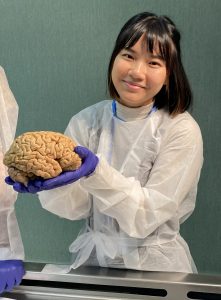 CNS: How did you become interested in the intersection of memory and spatial navigation?
Nguyen: I was first introduced to memory research, specifically spatial navigation, and fMRI as an undergrad research assistant at UT Austin. I was always curious about memory, but as an undergrad, I didn’t really know where to start or that “memory” itself was a huge umbrella term for so many cognitive processes. Spatial processes are so integral to our everyday lives. I think this field of research has taken so many creative and out-of-the-box approaches to unraveling how humans interact with their environment, some methods that I got to explore throughout my research career. Personally, I was inspired by the researchers I’ve gotten to work with in this field and it was important to me to be able to explore my interests with them and carve out a path for myself.
CNS: What was the new insight you were seeking with the new study?
Nguyen: Dr. Nora Newcombe, my PhD advisor at Temple University, and I had many conversations about how memory models informed by human adult data did not fit well with what we know about child development. Memory processes that seemed discrete in adulthood weren’t clearly delineated in children. We wanted to understand if we should continue to think of episodic memory and spatial processes as distinct when, in real life, we do not experience the world exclusively as an episode or as a navigation trajectory; they’re intertwined. For this paper, the goal was to see how information from these intertwined cognitive processes was stored in the brain, with the novelty of understanding how children’s brains support these processes during a time when memory integration continues to refine with age.
CNS: What were you most excited to find? Were any findings surprising?
Nguyen: I was excited to find age-related changes in activation in the entorhinal and perirhinal cortices; previously we knew very little about the functional development of these regions. I was anticipating to find activation in the hippocampus, which we did not find! We were surprised, as noted in the paper, but there’s always room for improvement for future work. As scientists, we are tasked with making sense of the data we have, and the beauty of research is that you’re never guaranteed confirmation of your hypotheses.
CNS: What do you most want others to understand about this work?
Nguyen: There’s a lot we can learn from children. Understanding how children tie together different types of information has implications for classroom learning and working through complex problems.
For the general public, the most rewarding way to understand this work would be to get involved in research, if that interests you. The families I worked with really enjoyed being a part of science, learning about the brain and memory, and seeing a picture of their child’s brain!
CNS: What’s next for this line of work?
Nguyen: I would love to see researchers take a more real-world application approach to studying memory systems. From recent papers, I think research is moving toward virtual reality to real-world translation because there is so much complexity in real life that is difficult to replicate in a controlled lab setting. It’s unlikely that there’s only one method for how to bridge this, but I hope that my work has contributed somewhat to the conversation.
CNS: Is there anything else I didn’t ask you about that you’d like to add?
Nguyen: I want to add that this paper in JoCN has accompanying behavioral findings reported in a prior publication. These two papers are derived from the same dissertation work I did at Temple. They truly are sister papers, so if the reader has time, I hope that they also check out the behavioral paper.
-Lisa M.P. Munoz
