
 CNS 2025 guest post by Lauren Homann (CNSTA president)
As cognitive neuroscience trainees look toward the future, many are considering options beyond traditional academic pathways. With growing uncertainty around research funding, increasing academic precarity, and a shifting policy landscape, the scientific world is in flux. These challenges, while daunting, also invite a reevaluation of what a meaningful and impactful scientific career might look like.
At the 2025 CNSTA Career Panel—held during the Cognitive Neuroscience Society (CNS) annual meeting—four Ph.D.-trained professionals shared their experiences navigating careers across academia, industry, entrepreneurship, and consulting. The panel emphasized that while the post-PhD world offers a wealth of possibilities, it also demands adaptability, a willingness to take risks, and a rethinking of what success can look like.
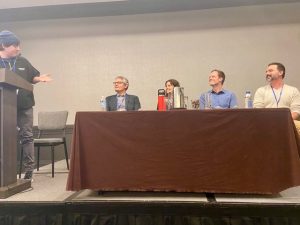
The panelists (pictured above) included James Antony, an assistant professor at California Polytechnic State University, whose role prioritizes teaching while maintaining an active research program; Kyla Alsbury-Nealy, founder of SilicoLabs, a leading Canadian startup specializing in no-code XR software for research; Gordon Kraft-Todd, partner at Ker-Twang, a human-centered design consultancy tackling complex social issues; and Brad Voytek, a professor at the University of California, San Diego, who was previously Uber’s first data scientist during its startup era. Together, they offered candid insights on skills development, risk-taking, failure, and the value of nonlinear career paths.
You have more skills than you think
A central theme throughout the discussion was that PhD trainees often underestimate the breadth of their skill sets. Antony emphasized: “You have more skills than you think.” He highlighted core academic competencies—such as writing, public speaking, and managing complex projects from start to finish—as highly transferable.
Voytek agreed, stressing the power of a broad knowledge base and encouraging trainees to seek out the right opportunities for them, where they can leverage their diverse skills. Kraft-Todd noted that PhDs often thrive in industry due to their strong analytical abilities. Meanwhile, Alsbury-Nealy emphasized that flexibility and a willingness to learn were key strengths she brought to founding her company.
Taking strategic risks
Risk was another shared theme across all four career stories. Antony noted that innovation, whether in research or career development, requires a willingness to take chances. Some of his projects were risky but ultimately impactful, shaping his current trajectory.
Alsbury-Nealy explained that she relied on a strong “Plan B” career in physiotherapy, while also trusting the “good signals” from mentors and advisors along the way.
Voytek recommended a practical mental exercise for assessing one’s tolerance to risk: Imagine the worst-case scenario and ask yourself if you could tolerate that outcome. Kraft-Todd offered a broader reflection, noting that our sensitivity to risk evolves over time as our circumstances change—and that’s perfectly okay.
Breadth vs. Depth: When to Specialize?
The panelists also reflected on the balance between generalization and specialization, advocating for a dynamic approach. Voytek spoke about recognizing when to dive deep—usually when mastering a method is necessary—and when it’s better to stay broad. “You’ll start to recognize those moments,” he said. “I know what I should know, so now I’ll dive deep.”
Alsbury-Nealy echoed this idea, explaining that her business requires breadth due to its many moving parts, but she still develops deep expertise when necessary. She added that engaging in a variety of activities during her Ph.D. helped her later navigate complex challenges in her startup.
Antony encouraged his students to explore broadly early in their careers, as it sharpens thinking and helps build foundational skills. However, Kraft-Todd cautioned that in some academic settings, deep specialization remains critical. Ultimately, it’s about knowing your goals and adjusting accordingly.
Navigating failure and a reminder on what failure is not
Navigating failure emerged as a major theme, with the panelists offering powerful ways to reframe it. Alsbury-Nealy urged trainees to “feel the feels”—to experience failure, but also to look for lessons and remember that there’s almost always another chance.
Kraft-Todd recommended celebrating efforts over outcomes, such as submitting a paper, regardless of whether it’s accepted. Voytek and Antony emphasized the importance of developing thick skin. Criticism, they said, is about the work, not about you as a person.
Antony also offered a resonant reminder, saying: “Leaving academia is not a failure. Period.” In fact, leaving academia is often necessary to translate research into real-world impact.
As the academic and professional landscape continues to evolve, today’s cognitive neuroscience trainees are uniquely equipped to lead the way—wherever their paths may take them.
Practical tips for industry and academia
For those considering careers beyond academia, the panelists shared practical advice. Kraft-Todd suggested seeking out bootcamps to build missing skills and emphasized the importance of networking.
Alsbury-Nealy recommended showing enthusiasm and interest when applying for jobs. When hiring, she looks not only for skill sets but also for a person’s interest in the company and fit with the team. For those launching their own ventures, she suggested exploring accelerators and incubators to test and grow new ideas.
Voytek encouraged students to pursue internships during their PhDs, as they provide valuable exposure to industry and bring fresh perspectives back to the lab.
For those pursuing faculty roles, Antony and Voytek both stressed the importance of strong application materials, including publications, compelling diversity and teaching statements, relevant experience, and strong letters of recommendation. However, Voytek noted that departments vary significantly in their hiring priorities, and “fit” with a department (i.e., whether you might teach a course the department wants for its students) can be just as crucial as other aspects of your CV.
Final thoughts
The panel closed on an encouraging note. As the academic and professional landscape continues to evolve, today’s cognitive neuroscience trainees are uniquely equipped to lead the way—wherever their paths may take them.
–
Lauren Homann is a PhD student at the University of Toronto, where her research focuses on how humans perceive, learn, and remember. She has been the president of the CNSTA since 2024.
