
For people who know Caitriona Douglas, it came as no surprise that she decided to pursue research that does fine-grained analysis of conversations.
“I grew up in a bilingual environment and had childhood speech and language disorders,” Douglas recalls. “For me, a major turning point was getting more involved in music and drama, where I had to slow down my vocalizations and match them to the contexts of the scenes I was co-creating with others. I remember my life slowly transforming as I realized that these skills I learned in music and drama could be used throughout my life and allowed me to interact more effectively with my world.”
In her research at Dalhousie University, Douglas sought to understand how language works in real-world settings rather than controlled laboratory ones. Using a technique called EEG hyperscanning, she and colleagues were able to collect data from two people simultaneously while they were having a conversation to see what happened when they encountered less familiar or more familiar words. Their findings, published in the Journal of Cognitive Neuroscience, show that engaging in conversation can facilitate access to less frequently used words and reduce the neural processing generally associated with them.
I spoke with Douglas about this research and its implications for the field, as well as her own path in research, music, and theater.
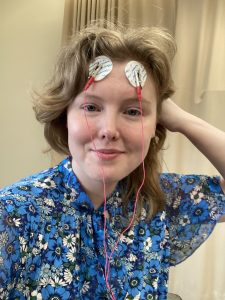 CNS: How do you like to explain how hyperscanning using ERPs works and why it is important in studying language processing?
Douglas: Hyperscanning refers to recording neuroimaging data from multiple people simultaneously. Most research in hyperscanning to date has focused on how neural rhythms synchronize between interacting individuals over the duration of an experimental task or condition. In event-related potential (ERP) research, we are looking at the specific timing and neural responses to specific words or events within a conversation, to gain better insight into exactly when and how the brain processes specific stimuli. For example, my research looked at someone’s neural response at the exact moment they heard an uncommon word within a conversation. Previous interbrain synchrony hyperscanning research on conversations has mainly examined whether or not two conversational partners’ neural rhythms synchronize while they have a conversation (spoilers: they do, and it’s pretty cool).
Basically, an ERP effect is made up of many individual event-level responses each participant has in response to stimuli averaged out. Let’s say I present the sentence I take my coffee with milk and dog to a participant. Generally, healthy people tend to display a specific neural electrical response detected at the electrodes positioned at the center of the scalp about 400ms after they see the word dog. When we present 100 sentences that resemble “I take my coffee with milk and dog” to 30 participants and average all their event-level responses to the strange out of context word in that sentence, we see the N400 ERP effect.
CNS: Can you tell me more about how this effect relates to the brain processing words?
Douglas: The N400 is a marker of lexical frequency that relates to how easily your brain understands the meaning of a word. Words we hear less often require more of this processing for us to understand their meanings. For example, I put on my galoshes before leaving the house” is a low lexical frequency word and requires more processing whereas “I put on my boots before leaving the house” features a noun with high lexical frequency and requires less processing.
CNS: What were you most excited to find? Were any findings surprising or contrary to popular opinion?
Douglas: I was excited to replicate an effect found in controlled isolated laboratory conditions in a setting with two people present in a conversational setting. One surprising finding was that our control group of people who watched a video of a conversation in pairs exhibited a larger ERP effect than our experimental group who had the conversation together, though the effect was present in both groups.
CNS: Were there any novel techniques/approaches in your study that you would like to highlight?
Douglas: I would highlight that we developed a technique that allows researchers to use a single EEG system to conduct a hyperscanning study, meaning that researchers can conduct hyperscanning studies using their existing apparatuses without having to invest in multiple EEG systems, which can be a major financial barrier to entry to hyperscanning research. I would also highlight that the scripted conversation task I developed and used in this study was highly influenced and borrowed from my experience in improv and theatre. It showed that participants who were untrained in the arts could easily follow and perform a task that many people who we consulted in our pilot phases thought would be impossible.
CNS: How does this study represent a new step in more naturalistic neuroscience experiments?
Douglas: I hope that my study encourages more people to do hyperscanning research. And I hope that it encourages more people to think outside of the box on how to create or modify tasks and experimental settings that resemble real-world settings.
CNS: How might this work be applied in the future?
Douglas: Imagine if we continued studying this and developed a better understanding of event level responses and language disorders. Maybe doctors could hook a person up to an EEG system, have a conversation, and diagnose a specific processing issue and treatment based on a simple conversation and how that person processed the interaction?
CNS: What’s next for this line of work?
Douglas: It’s hard to say for sure. With public research funding increasingly at risk at and research being more likely to be funded to be in the interest of big tech and industry, I worry that the focus and implementation of hyperscanning research and real-world neuroscience may head toward a kind of social engineering instead of basic research. I really hope to see more experiments that conduct research in real-world conditions, using real-world stimuli.
CNS: Is there anything else I didn’t ask you about that you’d like to add?
Douglas: I get a lot of questions about why I have not pursued a PhD and what I am up to these days. I think the fairytale we tell in science is that if you are really lucky in undergrad and stumble upon an outstanding research project, you’ll be able to publish papers, get research funding, and academic positions. And I was really lucky; I stumbled into this absolute gift of an opportunity at Dalhousie University in my undergrad and my masters. And I conducted a really amazing research study.
I ended up having an amazing opportunity to pursue a music therapy master’s that will certify me as both a music therapist and psychotherapist at Wilfrid Laurier University. I’ve been able to do some hyperscanning research alongside this degree as well. I earn enough to scrape by through a combination of scholarships, work, and music gigs. One of my main areas of work is as a theatre technician: You can find me programming light and sound cues for shows that are precisely timed with a performer’s speech or music. I love research, but I also love hearing the audience gasp when I hit a cue that coincides with the performance timing perfectly.
-Lisa M.P. Munoz
